Stage
fright
Causes and remedies
for musicians
Especially VIOLA playing
(and violin, fiddle too, of course)
IT WORKS!

Buy Viola in Music's Collection of
13 famous tunes
Read more
Stage fright ...
scary subject.. why should one want to talk or even think about it?
Maybe you
think there can be something that could help you
overcome stage fright or nerves, fear, performance anxiety, worry,
all the names this can take, when performing for any sort of audience?
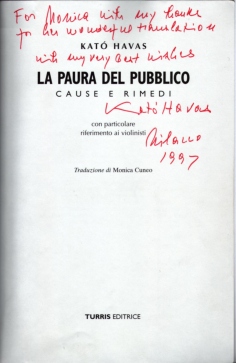
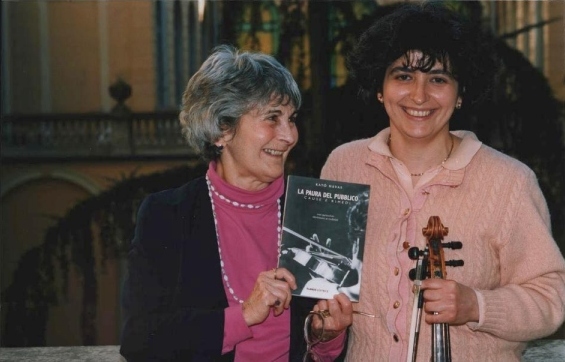 Kato Havas at the presentation of the book Stage Fright in Italian translated by Monica Cuneo, with her in the photo
Or would you like to be more in control of your playing and of yourself during a performance? And since music is communication, do you feel you could communicate with your listeners (they may communicate to you as well!) and enjoy the experience?
So
you've come to the right place, I'll tell you my personal
experience, maybe it can help, I used to get really badly nervous when
playing, with all the negative
consequences.
This is one of the, literally, most frightening problems that performing musicians have to face,
often without knowing what to do
about it. Not only musicians suffer from it but, as far as I
know, all performers and nearly everybody who ever had only to speak in
front of an audience has experienced it.
For music
performers it is particularly serious because when you play
with
somebody else you can't just stop and start again or explain it better,
as a speaker could do.

Are
there remedies for stage fright?
Being
such a big problem, you can bet people have tried hard to find a
solution to it. Some try to find a medication for stage fright,
tranquillizers, some resort to beta blockers, for others a remedy could
be just a good glass of wine or whisky or similar. Others,
during a performance try to think "not
to be there" or that the audience is not there. This may
help
to get through the piece doing all or most of the notes correctly but,
since music is
communication, how or what can you communicate to a
listener if you are not
there, or your mind is not fully alert?
As
an experiment, try and do the same when you actually talk to someone and
see what happens, what reactions you get.
If you are
happy with these remedies, good for you! You can go
to another page
in this website, I hope you find something else useful to you, don't
waste time reading this page. Instead, if you are looking for a
different type of help about this, keep reading. I personally
never wanted to use any of these remedies, because I thought they
didn't address
the cause of stage fright. Also it seems to me that our
society is getting more and more drug-oriented,
I mean, for all sort of problems (from stage fright to insomnia, study,
anxiety, sex, happiness or lack of it, etc. etc. and whatever
"disorder" someone may say you have), we are told that there
is
a pill to take to get rid of it. Quick and easy solution (and
very
lucrative for pills producers/promoters, but that's a different
matter).
I don't believe these things, I like
"natural remedies", they may take a bit longer but work better.
Indeed, it is
possible
to overcome stage fright without
drugs and feel the emotion, the thrill of enjoying a
performance.
There
can be other factors
in somebody's life, which have no relation at all
with music, that can seriously undermine one's confidence and therefore
play a major part in building stage fright over time, although the
technical aspects of playing worry most players.
"Stage
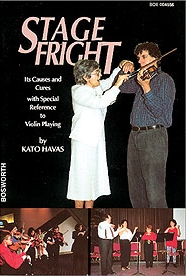
fright" is also the title of a book
that analyzes all aspects,
physical, mental and social, of
stage
fright, and gives practical solutions
to the issue and I found
it very useful. It is written by Kató
Havas,
the famous
violin and viola teacher who wrote also other books about
violin (or,
better,
string) playing. She was a child prodigy on the violin and performed
extensively as a soloist, therefore she knew very well all the problems
involved with playing and performing as a soloist. Then she made her
own family and later developed what she called the New Approach to
violin/string playing, which enables players to play with ease and this
ease helps to overcome stage fright.
Come to my workshops: How to eliminate stage fright and musicians' injuries
Causes of stage fright
First
of all, it's important to understand what is the cause of stage fright.
It's
similar to any other fright: if we know we are not able to control
something, we get fright. Just to give you an easy
example: you are happily driving your car, you
know how to do the various things, in a word, you can control your car.
But, suddenly, the road is icy, slippery, you want to turn left but the
steer doesn't work, your car goes straight. You start getting some
fright, so you want to stop it but because of the ice the brakes have
no effect; you get more and more fright because now you know you can't
control what's going on and eventually you and your car end up against
the rail of that curve (my experience, I told you).
The
same thing happens when playing an instrument, in our case, viola or
violin. The more you know you can't control the technical aspects of
what
you are doing, the more you are going to worry about it. In fact, we
tend to get more nervous about
difficult things like fast passages, double stops, shifts, because most
of times we are not sure we can control them.
This
is the first aspect addressed by Kató Havas in her books and her
approach
to playing.
The books of Kató Havas
Nowadays, many give
advice about stage fright, but bear in mind that the book I'm
going to illustrate here was first published
in 1973,
when talking about this was not such a common thing as today.
This book followed two other very successful books, "A New Approach
to violin playing" and "The
twelve lesson course,
in a new approach to
violin playing", about the prevention of physical injuries in
playing. This also was something nobody talked about, back in 1961!
when the New
Approach,
was published. Now everybody is well aware of performers' injuries and
there are even clinics specialized in the cure of them. I love Kató
Havas's books and her approach because they
don't cure the
symptoms, they go to the source and eliminate
the cause of the problems.
So, you can
be sure that a lot of people have read these books and got
at least some inspiration. After all these years, they still sell well,
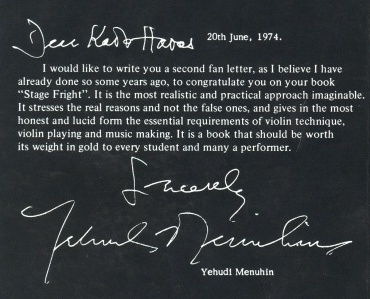
and in several languages. Read what Yehudi Menuhin said
about the book "Stage
fright" in a congratulation letter, you can find it on the
book back cover.
Please,
note that although
the book titles refer to our little brother, the violin, their
principles and practice apply
to the viola as well and also to all string
instruments, somebody wrote a book about cello playing. Indeed,
in the book "Stage
fright" there is a specific reference
to the viola,
since any problem
one could have with the violin becomes only bigger on the viola,
because
of its very size. These
principles have to do with how
to use our body (and not only the fingers!), particularly
all the upper
part (shoulders, arms, back) in a natural way, to prevent or eliminate
various physical and emotional problems caused by an incorrect use of
the body in playing. This, at the same time, facilitates
the performance
and makes it more enjoyable for the performer. Well, who plays knows
what the problems are, right?
That's the meaning
of "New
approach". The violin is always referred to
because Kató
Havas is
a violinist and started with the violin, but there are other people and
books
who apply this approach to other instruments. In developing this
approach based on the physical side of playing, the release of physical tension,
it appeared that this release was helpful also in the release of mental tension,
so "Stage fright"
is a sort of summary of both approaches.
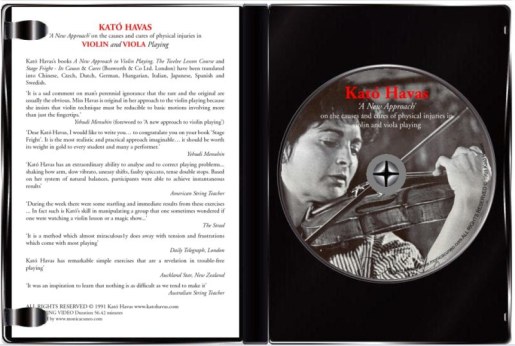
Buy
Kato Havas teaching video -
£19.00/$29.99
+pp
All
her books and this DVD are for
practical use, you shouldn't just sit there watching it or
reading: stop and do what they say, apply the exercises.
The book
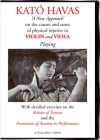
Stage fright
Its causes and
cures
In
1996 I was asked to translate this book into Italian
in view of a forthcoming workshop in Italy with
Kató Havas.
So, I read the
book and accepted to translate it (the picture here is the Italian
version's frontispiece).
While doing the translation, in order to understand
it better
and be able to explain it in another language, I tried the exercises
suggested, to see if it made sense and... it did make sense,
they made several technical things easier (that's actually the way you
should use
this book, not just read it).
What
struck me when I read this book was that it was really concrete, not
just good theory: indeed, in each chapter, for each problem you'll see
that causes and
cures are indicated,
together with practical
exercises.
Here you will
find a description of the book and of the topics analyzed in it and,
most important, the solution
to the problem.
The following are the book
chapter titles, which cover all aspects of playing. Click
on each link to read a description of it.
II) THE HUNGARIAN GYPSY VIOLINIST
III) THE PHYSICAL ASPECTS OF STAGE FRIGHT
IV) THE MENTAL ASPECTS OF STAGE FRIGHT
V) THE SOCIAL ASPECTS OF STAGE FRIGHT
VI)
CONCLUSION
I) A GENERAL SURVEY
- THE SHAME ATTACHED TO STAGE FRIGHT
- THE
SYMPTOMS OF STAGE FRIGHT
a. What is anxiety? - ARTIST-AUDIENCE RELATIONSHIP
If you ever wondered if it's only you suffering from stage fright, in this chapter you can read how nearly everybody suffers from this fear, maybe without admitting it, feeling ashamed of it. What happens when struck by stage fright (you may know it from personal experience, but it's useful to read about others as well), how the relationship between performer and listener is related to stage fright and what to do about it.
II) THE HUNGARIAN GYPSY VIOLINIST
Here is a description of the Hungarian gypsy violinist, his complete ease and physical well-being at playing, his only focus on giving pleasure to the listener. Kató Havas is Hungarian and in her childhood she met these extraordinary players and was fascinated by them. Indeed, many were fascinated by their artistry, including Liszt. Kató Havas always refers to them and was inspired by them in developing her New Approach.
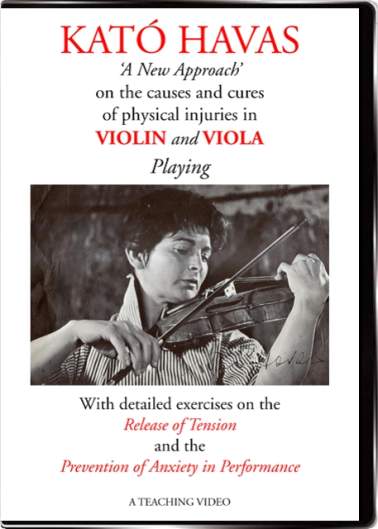
Buy
Kato Havas teaching video -
£19.00/$29.99
+pp
(it
works on all DVD players and on computers)
How to eliminate and prevent stage fright & physical injuries
III) THE PHYSICAL ASPECTS OF STAGE FRIGHT
- THE FEAR OF DROPPING THE VIOLIN
- THE
FEAR OF THE TREMBLING
BOWING ARM
a. The stokes - THE
FEAR OF BEING OUT OF TUNE
a. The fourth finger - THE
FEAR OF HIGH POSITIONS AND
SHIFTS
a. High positions
b. Shifts
First of all, it's necessary to solve the problems concerned with the physical side of playing. So here, for each of these universal fears, there are causes and cures explained, together with practical exercises.
How to use the natural body balances and movements to get to master the high positions and shifts, have a flowing bow arm and in control, how to prevent stiffness in the weakest finger and all hand.
But don't just read it, do it!
IV) THE MENTAL ASPECTS OF STAGE FRIGHT
- THE FEAR OF NOT BEING LOUD
ENOUGH
a. Hearing
b. Listening - THE FEAR OF NOT BEING FAST ENOUGH
- THE FEAR OF MEMORY LAPSE
- THE POWER OF WORDS
- THE POWER OF IMAGINATION
Causes and cures: tips to practice fast passages, how to learn a piece to play by heart, which words create a mental state of tension, while others help to create ease and flexibility, so you know which ones to use when talking, teaching, even thinking about playing. How to use your imagination for help with this and to create your musical communication.
VI) CONCLUSION
- THE ART OF PRACTISING
- SUGGESTIONS FOR EXAMINATIONS, AUDITIONS, COMPETITIONS, PERFORMANCES
- THE SALIENT POINTS IN PRACTISING
From reading the whole book, you'll have seen that playing and practicing is more a matter of mental attitude, not a mechanical thing, it's about what we mean to do with it. Here is some general advice about how to practice (see why practicing itself can be a major cause of stage fright), prepare for performances. So change your attitude and you change the results. Read quotes from the famous violin player Fritz Kreisler, who was famed for not practicing much, see what he says about relying on muscular exercise only and about practicing before a performance.
Other things you can do
When I was working on this, I did all sorts of musical thing, quite unusual for a classical player, which could, in one way or another, be helpful in improving my playing: I started playing with folk players, in pub sessions, processions, learned to play by ear (and more..., you'll see later on), just to regain that genuine feeling of doing it for pleasure, without worries.
We get used to think that if we make a mistake it's a tremendous crime, so we focus our attention only on not making any error, forgetting the musical communication. Of course, it's nice not to make mistakes, but if that becomes your only concern, oh, what a boring drudgery!
One learns from mistakes, so, something else you could do to overcome stage fright, is find situations to play where you are allowed to make mistakes because people are not there to judge you but they are only willing to receive and enjoy your music. When speaking with my students or other players who say they get nervous, I advise them to go and play at their church during a function, or play at an elderly people's home or play for little children, easy things to make them enjoy it, have fun, tell them a story. Even if you make some mistakes, so, what's going to happen? They'd never notice it but they would love you for the gift of music that you can give them, they'd ask you for more music and this will help you to build confidence in yourself, in your ability to play and to communicate and you'll be able to play more and more demanding pieces.
Then you can go home and practice the passages that need improvement. And if you can play by heart, without reading the music, much better, so you can look at people right in their eyes, "talk" to them with music, smile. Start with something simple and enjoy it.
If you still need some practice in performing your piece in front of an audience before a big event, the final touch, for many the scariest thing you can do, is some busking. Yes, go and play in the streets, there you have an audience, the situation is challenging, it may be noisy, people coming and going, a lot of distractions, you may have to cope with the idea of "what will they think of me?" (but who cares what they think?), but if you can cope with this, then performing in any other situation will seem easier.
To conclude, you can do something about stage fright, without drugs, improve your playing and enjoy yourself when you play, feel the emotion of making and giving music to your listeners, cause emotions in your listeners. Start giving your music to everyone, see the nice comments you might receive...

and people dancing to your music...
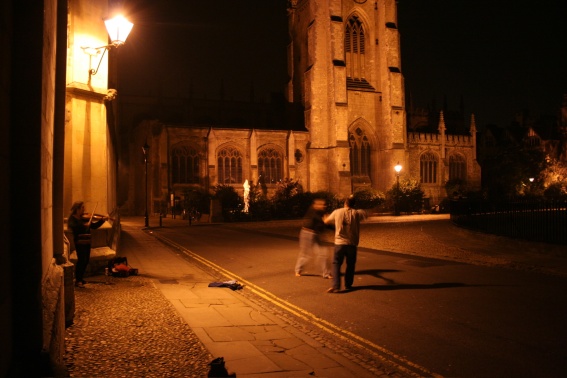
and you'll feel much more confident and able.
I
found these
books I mentioned very useful
and if you have
any doubts about how to solve some problems and so far you haven't
found answers, I warmly recommend them to you!
Buy the book "Stage fright", read it and apply it, day by day. Then, if you want some more help and tips, get in touch, I do teach viola and violin. This is the way I teach and I see that my pupils have a nice tone from the very beginning, enjoy themselves much more, learn more quickly. Playing is not just doing all the right notes, as Kató Havas says:
"It is important to realize that our responsibility as musicians lies just in this - in the lifting up emotionally and aesthetically of all our listeners, regardless of whether they are examiners, auditioners, or members of an audience. If all our energies were channelled into giving people, through the medium of music, a deeper understanding of their own potential as part of the wonderful mysteries that the universe contains, we would not only do justice to ourselves as musicians, but stage fright would be banished from the face of this earth forever."
Play easily without pain &
nerves

New! Comments
Have your say about what you just read! Leave me a comment in the box below.









Play easily without pain &
nerves
Related pages
Read the book "Stage fright - Causes and cures", by Kato Havas, and play freelyBuy Viola in Music's Collection of 13 famous tunes (19 pages)
£7.99 and download them instantly
They are in their original keys, so you can play them in sessions with other instruments
Jesu, joy of man's desiring
Michael Turner’s waltz (2 versions)
The
greenwood tree
The south wind
Fanny Power
Ye banks and braes
Skye boat song
My Bonnie
My love is
like a red, red rose
Sportsman’s hornpipe
The road to Lisdoonvarna
Danny Boy (Londonderry Air)
Iron legs

Do you like
Viola in Music?
Support it by buying sheet music here

Download Sheet Music
|



V) THE SOCIAL ASPECTS OF STAGE FRIGHT
Causes and cures: I personally think that this is the most difficult fear to overcome, because even when you have got rid of the technical problems that made you insecure, still there is the fear of other people's judgement. This applies to many aspects of life, but it's especially true of playing an instrument, it's the identification of one's personal worth with the "goodness" of playing.
I personally think that another way to help reduce stage fright is to try to eliminate this attitude of fierce criticism, so prevalent especially among music students and no-longer-students. The more you criticize, the more you are bound to be nervous when your turn to play comes, especially in front of "friends" or people you know, because you are aware of what they would think of your performance and, what's worst, of you as a person. So, why not try and stop criticizing other players for every tiny mistake or other things? I adopted this attitude, "OK, that's the way he/she plays, it's their choice, it's not my job to judge other people's playing, it doesn't make me a better player so what's the point of criticizing?" By the way, I've found it useful not only for music, but for other situations, it makes me more tolerant of other people's faults and less worried about their judgement.