
How to find your right
Viola Size

Buy Viola in Music's Collection of
13 famous tunes
Read more
The viola size is the first difference between violin and viola that you can notice easily, I mean if you have the two instruments in front of you to compare: the viola is bigger. The viola body length goes from 40 cm (15 ¾ in) to 42/43 cm (16.5/17 in) and it is larger accordingly, while the violin body is about 35 cm (13 ¾ in).
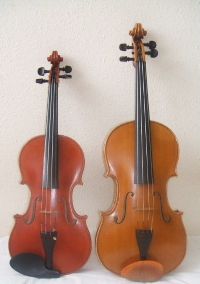
There are even bigger instruments, there used to be more in the 16ᵗʰ, 17ᵗʰ and early 18ᵗʰ century because viola music was very simple. Later they cut them down, to make them more comfortable to play.
Now it can be quite dangerous to play one of them, especially for a long time and for difficult pieces. It could cause physical damage to the player because he or she would tend to stretch his or her arms and left fingers and use a lot of pressure with the bow to draw a big tone from the instrument. Players of all instruments have already enough of these problems with normal sized instruments, they don’t need to make their lives even harder.
The famous viola player Lionel Tertis had a serious physical problem in his right arm and had to stop his professional activity. Maybe it was because of the big instrument he used to play, a 43.5 cm (17 ¹<span style='font-size: 50%'>/8 in) viola made by Domenico Montagnana in 1717. So, bigger is better... within limits.
Some players, often violin players who occasionally play viola and find it too hard (and make me wonder "why do they still play it?"), use smaller violas (38 cm/15 in), but our Tertis would place these violas in the category of the "so-called violas". Anyway, a small viola like this wouldn't be considered a good instrument for a professional viola player.
Also viola strings are slightly longer and thicker and the viola is played with a slightly heavier bow.
This difference in size goes together with the different viola tuning and they give the viola its special, different timbre, its darker and warmer tone quality.
Read more on viola size and big violas in the page about the history of the viola.
How to choose your viola size
There is an easy way to choose the right viola size for you.
Stand with your left arm as you you were to play, put on your shoulder/collar bone the instrument you are trying. Then, hold the viola with your right hand, extend your left arm, without stretching it, to reach the viola scroll. If you can barely touch the scroll with your fingertips, that viola is too big for you, it would be too much of a strain for you to play such an instrument.
On the other hand, if you can rest the scroll in your left hand, comfortably, without stretching, with your fingers gently curling around the scroll, that is the right instrument for you, I mean, that is the maximum size you should choose. If you are very tall with very long arms, you could also choose a smaller instrument for more comfort, not necessarily one has to play the biggest viola.
By the way, this is also the way to choose the right violin size for children when they start, either a full size or ¾, ½ etc.
So, choose the right size for your instrument and enjoy playing it for many years. Check this other page for more tips on how to prevent and eliminate aches and pains and worse things like tendonitis and other problems related to viola playing.
Find what you are looking for, use this search box
Go back to from Viola Size to Differences between Violin and Viola


Find what you are looking for,
use this search box

Buy Viola in Music's Collection of 13 famous tunes (19 pages)
£7.99 and download them instantly
They are in their original keys, so you can play them in sessions with other instruments
Jesu, joy of man's desiring
Michael Turner’s waltz (2 versions)
The
greenwood tree
The south wind
Fanny Power
Ye banks and braes
Skye boat song
My Bonnie
My love is
like a red, red rose
Sportsman’s hornpipe
The road to Lisdoonvarna
Danny Boy (Londonderry Air)
Iron legs

Do you like
Viola in Music?
Support it by buying sheet music here

Download Sheet Music
|




New! Comments
Have your say about what you just read! Leave me a comment in the box below.